How We Built Charlie, Part 15: What We Learned Building Charlie
What we learned about making AI engineering work owned, bounded, verifiable, and useful to a team.
GPT-5.6 brings stronger judgment. An updated Charlie harness puts Sol, Terra, and Luna to work in parallel.

Today, we’re shipping a new version of Charlie, powered by OpenAI’s GPT-5.6. Its stronger judgment lets Charlie proactively and autonomously take on more engineering work that would otherwise wait for someone to notice it, investigate it, and move it forward.
A stuck PR, a production alert, or a bug report can trigger careful investigation, a mergeable fix, or a reviewable next step. Charlie’s updated harness lets him parallelize the independent work behind those decisions.
GPT-5.6 helps Charlie make those calls: choose the right investigation, surface uncertainty, and delegate work that can safely run in parallel.
More capable reasoning does not automatically create faster execution. A serial agent run turns every search, tool call, and implementation step into a queue. GPT-5.6 can turn an ambiguous engineering task into an execution plan: identify the work that needs maximum reasoning, delegate questions, and wait to synthesize until the relevant evidence is back.
Charlie uses all three GPT-5.6 models: Sol, Terra, and Luna. Sol plans, delegates, and synthesizes. Terra and Luna workers handle implementation, exploration and review, or follow-up work. Workers can also delegate, forming durable task trees that track parentage, avoid duplicate child work on retry, and let multiple trees progress at once.
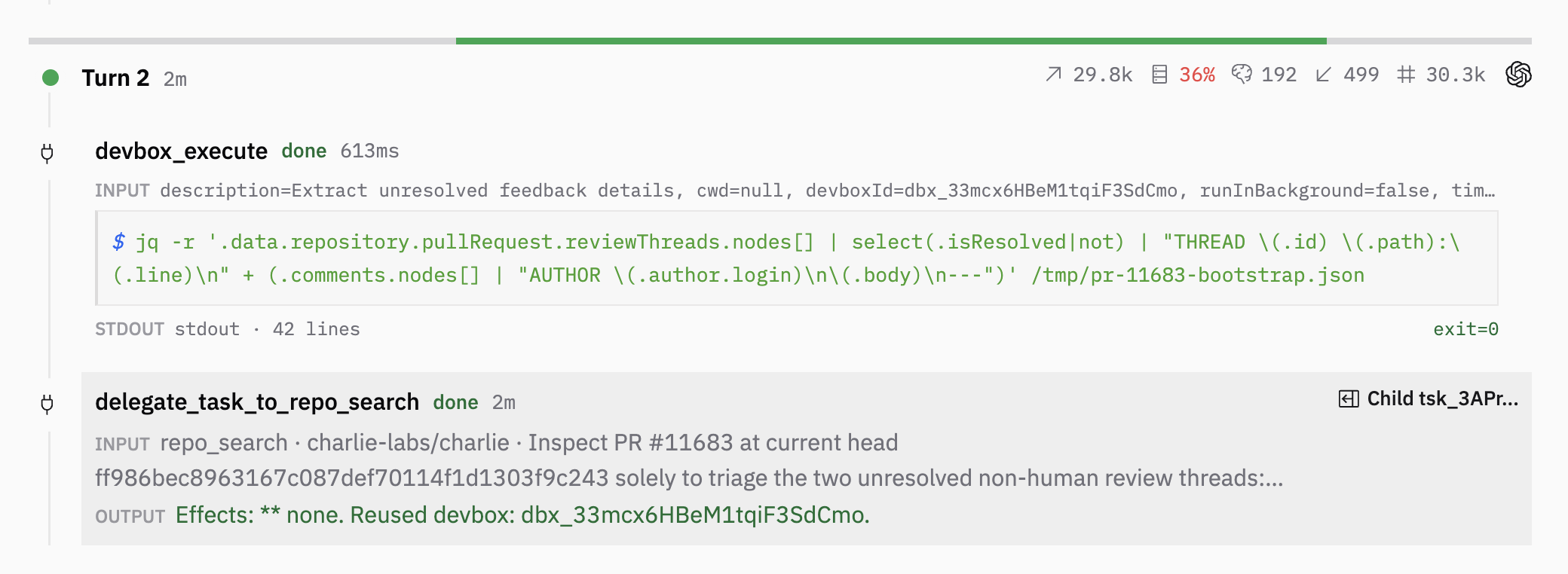
Within one turn, Charlie retrieves unresolved review feedback and starts a child investigation for focused repository research.
GPT-5.6 identifies which questions are independent, which model should answer them, and where the results need to come back together. With GPT-5.6 leading, Charlie is much more likely to fan out investigation in a single turn. The table shows the share of turns with exactly the stated number of tool calls.
| Tool calls in a turn | Previous Charlie | Updated Charlie | Change |
|---|---|---|---|
| 2 | 0.5% | 3.0% | 6x |
| 3 | 0.3% | 4.2% | 13x |
| 4 | 0.06% | 2.6% | 45x |
While investigating an alert, Charlie fans out across Sentry, Linear, and Slack in one turn, then brings the evidence back together before deciding what to do next.
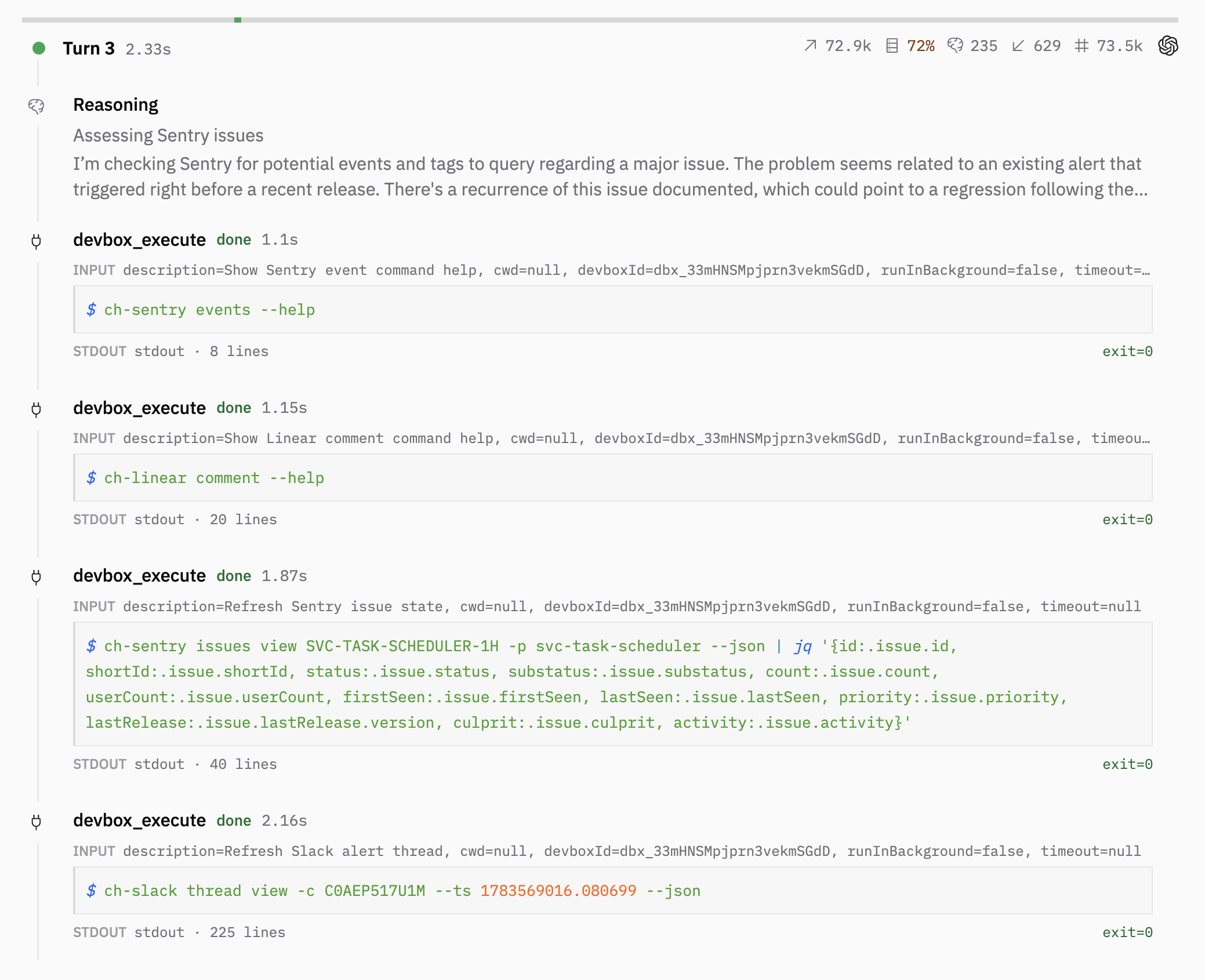
In the alert above, one 2.33-second turn completes four calls across Sentry, Linear, and Slack.
GPT-5.6 lets Charlie reserve Sol for the decisions that change an outcome and use Terra and Luna for faster follow-up work.
| Successful-call latency | Luna | Terra | Sol |
|---|---|---|---|
| p50 | 3.0s | 3.8s | 4.7s |
| p95 | 5.5s | 12.0s | 16.0s |
Output length drives much of the gap. At matched 1,000-4,000-token outputs, Luna’s p95 is 12.1 seconds, while Sol and Terra are about 1.9x and 1.8x slower.
GPT-5.6 turns ambiguous work into the right plan. Charlie’s harness turns that plan into parallel, delegated, and reviewable execution.
This GPT-5.6-powered Charlie is available today to all Charlie customers.

What we learned about making AI engineering work owned, bounded, verifiable, and useful to a team.

How legible Task state and artifact-linked updates give people one clear next action.