How Coforma Scales Engineering with Charlie
How Coforma uses Charlie across daemons, PR reviews, and dozens of application and infrastructure repositories.
The best software teams save human attention for the decisions that deserve it, use agents to extend that attention, and give recurring operational work an owner.

The best software teams save human attention for the decisions that deserve it, use agents to extend that attention, and give recurring operational work an owner.
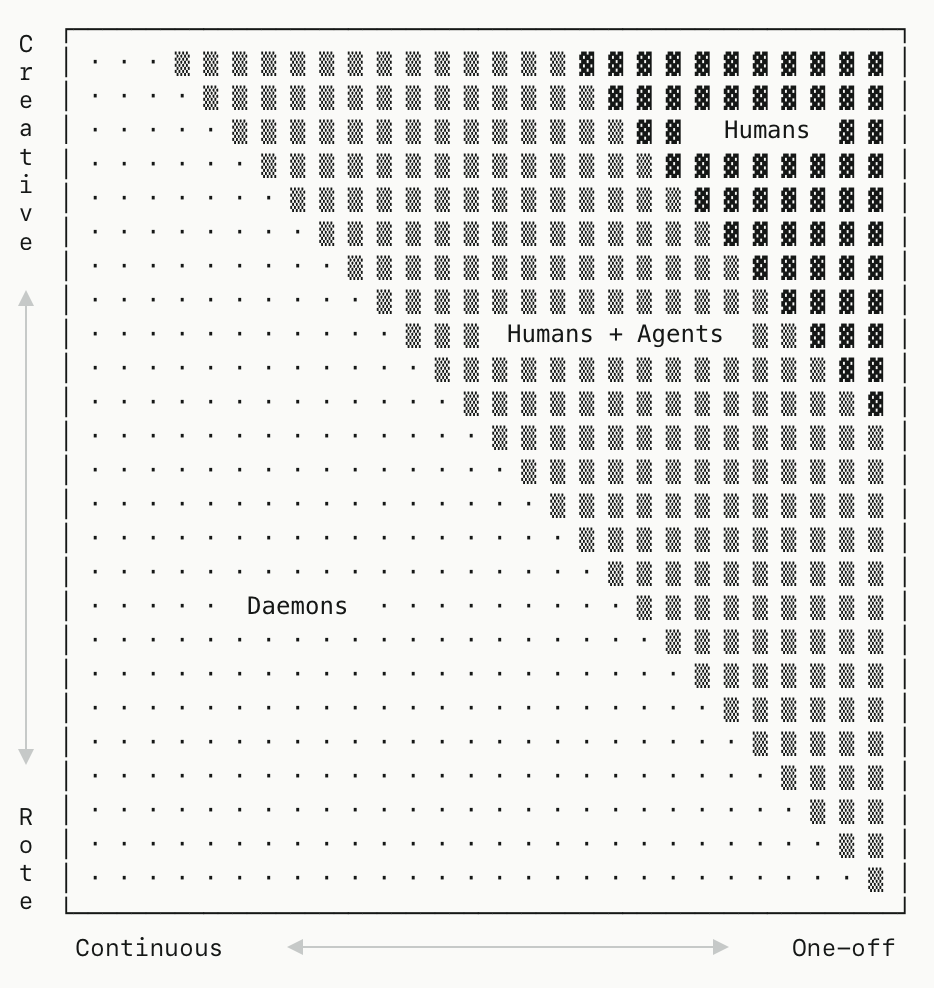
Take a look at the graph above. It maps software work along two dimensions: creative to rote, and continuous to one-off.
The upper-right corner belongs to human judgment. It is also the smallest part of the graph.
That is a feature, not a slight. Human attention is scarce, and software teams need it most for deciding what is worth building, making difficult product tradeoffs, applying taste, and changing direction when the evidence changes. Those decisions may occupy less space on the graph, but they shape everything else on it.
Software teams should protect that attention. Yet a lot of engineering work still asks humans to spend it on tasks that are important without being especially human.
Across the middle of the graph, humans and agents work together across a much larger share of software work.
Give an agent a defined objective and useful context, and it can investigate a bug, draft a migration, implement a feature, review a diff, or prepare a pull request. A human still sets direction and reviews the result. The agent helps turn that judgment into more completed work.
That model is already familiar: a person asks for a task, an agent helps complete it, and the task ends.
But a software system keeps changing after the task ends. The next pull request fails a check. The docs drift again. A dependency ages. An issue loses the right label. Feedback arrives without enough context to prioritize it.
None of those jobs is surprising. Most of them are not difficult in isolation. They are easy to neglect because they keep coming back.
That is the lower-left side of the graph: ongoing work with clearer boundaries and less need for fresh human judgment each time it appears.
Daemons give that work an explicit owner. A Charlie daemon is a repo-defined role that wakes when a relevant event occurs or a schedule fires, handles a bounded responsibility during that activation, and leaves reviewable output in GitHub, Linear, or Slack when it acts.
The distinction is simple:
That does not mean every maintenance task should run automatically or every decision should be delegated. Good daemon-shaped work has clear wake conditions, narrow boundaries, and reviewable outputs. The goal is to stop relying on someone to notice the same routine problem and ask for the same routine follow-through again.
Most teams already know what lives there. It is the small, persistent work that keeps software healthy: repairing straightforward CI failures, keeping documentation aligned with shipped behavior, maintaining dependencies, triaging recurring feedback, and cleaning up issue state.
You do not need to solve all of it at once. Start with one recurring job your team agrees should happen and should not need to be remembered.
Browse the daemon catalog and pick the one that fits: https://charlielabs.ai/use-cases/
Then get back to the smallest part of the graph. That is where your attention matters most.

How Coforma uses Charlie across daemons, PR reviews, and dozens of application and infrastructure repositories.

What we learned about making AI engineering work owned, bounded, verifiable, and useful to a team.